Search This Blog

Wednesday, September 11, 2013

2014 CHEVY CAMARO CONVERTIBLE BRINGS 'MURICA TO THE MESSE

2014 Chevy Camaro Convertible
By Steven J. Ewing, Autoblog.com - You might find it strange for Chevy to use its Frankfurt Motor Show stage to debut the droptop version of its very America-centric Camaro Convertible, but it's actually not that out of place.  Remember when Chevy took the wraps off of its new C7 Corvette Stingray droptop, it did so in Geneva.  Besides, it's nice to see a bit of 'Murican muscle storming the very Euro-centric stage.

You won't be surprised to learn that the 2014 Camaro Convertible gets all of the same upgrades as the refreshed hardtop variant, including updates to the front and rear fascias, as well as upgraded tech with Chevy MyLink inside.  The new (optional) Recaro chairs, however, are not offered on the droptop.

See below for GM's presser.

New Chevrolet Camaro to make first appearance in Europe
- New Camaro convertible to debut at IAA 2013
- Aero-optimized designed with hood vent, new grille and horizontal tail lamps
- New Chevrolet MyLink connected radio

FRANKFURT - At the 65th Frankfurt Motor Show, Chevrolet will debut the new Camaro convertible and coupe.  Featuring a fast, low-slung silhouette and Chevrolet's new MyLink connected radio, the latest edition of the famed American muscle car represents the most significant redesign since the introduction of the fifth-generation Camaro as a concept vehicle in 2006.

"Camaro has always been associated with iconic design, high performance and driving fun, and we are particularly proud of the new coupe and convertible models," said Dr. Thomas Sedran, President and Managing Director, Chevrolet Europe.  "They incorporate new high-tech features that add extra convenience and give customers even more value for their money," Sedran added.

Enhanced aerodynamics
The new Camaro boasts improved high-performance aerodynamics that provide more efficient cooling and stability at high speeds.  The front fascia has a wider lower grille and a narrower upper grille, while the functional hood vent helps reduce heat and aerodynamic lift.  At the rear, a sculptural deck lid, horizontal lamps and a diffuser complete the new design.  Both the coupe and the convertible sport a spoiler with integral antenna.

Power is supplied by the proven 6.2L V8 engine which is mated to a six-speed manual or an automatic transmission.  The automatic transmission model includes active fuel management and cam phasing (VVT).  The manual transmission version churns out 432 hp (318 kW) at 5,900 rpm and delivers a torque of 569 Nm at 4,600 rpm.  Zero to 100 acceleration is 5.2 seconds for the manual coupe and 5.4 seconds for the manual convertible.

Interior offers modern convenience and connectivity
Entering the new Camaro is straightforward and comfortable, thanks to standard remote keyless entry; on the automatic variant, customers can opt for a remote engine start functionality.  Leather-appointed power adjustable Recaro sport bucket seats can be selected in the front for the coupe variant.

Further interior highlights include a new color heads-up display and the new Chevrolet MyLink connected radio that is located in the center stack.  The radio is built around a seven-inch high resolution full-color touch screen and has a clean, icon-based display menu.

The new Chevrolet MyLink connected radio allows users to open phone books, personal playlists, and photo galleries from compatible smartphones.  Connectivity will be provided through USB, Bluetooth and aux-in.  In addition to voice recognition, the system offers text-to-speech capability, which allows users to listen to text messages from their smartphone.  A rearview camera is standard.

In addition, customers can opt to purchase an integrated navigation system with coverage of all of Europe.  As is the case with all Chevrolet MyLink radios, owners will be able to upgrade the new system with dedicated apps once they become available.

Competitive price tag for a true muscle car
The new Camaro will arrive at select Chevrolet dealerships across Europe toward the end of the year.  With prices starting from 39,990 for the coupe and 44,990 for the convertible in Germany, it is a compelling choice for performance-oriented drivers.

There is, however, much more to the Camaro than great value and affordability.  Its rugged strength, iconic design and unique muscle car attributes have stolen the hearts and imaginations of countless people and have provided subject matter for wall posters, T-shirts, and songs for decades.

Famously described to journalists in summer 1966 as a "small vicious animal that eats Mustangs", the original Camaro was built around a unibody structure and a 3.9L straight six engine.  Since then, five progressively more capable generations of the Camaro have thrilled car fans around the globe.  Until 1968, Camaros were assembled from complete knock down (CKD) kits at two General Motors' European plants in Antwerp, Belgium, and Biel, Switzerland.

Performance has always been an essential ingredient of Camaro's DNA and consequently, it has seen action in many forms of auto racing, including the spectacular drag races, where specially prepared vehicles, usually two at a time, compete along a straight course to make it first across a set finish line.

As much a part of Americana as apple pie and baseball, Camaros have featured in several Hollywood movies, such as Runaway Bridge (1999), a Walk to Remember (2003) and, of course, Transformers (2007, 2009, 2011), in which the Chevrolet Camaro sports car had a starring role as Bumblebee.

In March 2013, the latest edition of the Camaro Z28, considered by many to be the most iconic and exclusive model in Camaro history, was unveiled at the New York Auto Show.  Powered by a 7.0L V8 engine developed in conjunction with Corvette Racing and capable of churning out an estimated 500 hp (373 kW) and 637 Nm of torque, the new Camaro Z28 is suitably equipped to live up to the nameplate's proud heritage.

Technical data preliminary
Availability of voice recognition and text-to-speech in local language will vary across markets.

Friday, September 6, 2013

TREK BREAKS RECORD FOR MILEAGE


Lisa Calvi and Garry Sowerby broke the record for fuel
efficiency during a cross-Canada trek in a
2014 Chevrolet Cruze Clean Turbo Diesel
 
By Lisa Calvi, Postmedia News - We did it!  We broke a Canadian record for lowest fuel consumption.  My husband Garry Sowerby and I, drove from Vancouver to Halifax on the shortest route in a 2014 Chevrolet Cruze Clean Turbo Diesel.

After 5,956 kilometres, we had an average 4.21 L/100 km.  That's 67.09 miles per imperial gallon and beats the existing Canadian record of 5.59 L/100 km.  The Cruze consumed 250.9 litres of diesel fuel.  (More information on these statistics below.)

On the final day, Friday, Aug. 30, departing Woodstock, New Brunswick in the dark, a silence came over the cockpit.  After an hour, the first words Garry uttered were: "Once the fog clears, the big question will be which way is the wind blowing?  Will it be in our favour?"  He continued to mutter about getting 'the number' down.  It didn't sound good.

"You can't believe the numbers in my head!" he said.  "Elevation.  Average speed."

"Oh yes I can," I replied.  "You're saying them out loud!"

In silence again, I recalled a story he told me about a similar challenge run he made through Scandinavia in 1991.

That trip took place B.L. - Before Lisa, as I call the time before we met.  On that trip, the Fuel Nerd stretched his female travelling companion's patience to the limits.

Near the end of the run, as the incessant rattling and muttering of numbers intensified, she threw a jar of peanuts at Garry across a hotel room.

Through my musings in the car on that last morning, Garry cheerily and suddenly asked: "You ready to throw a jar of peanuts at me yet?"

Noting his confidence in the outcome, he adds: "If someone wanted to take a crack at breaking our record, they'd have to think hard about attempting it."

A road trip with the mission of beating a record must have parameters.  These were ours:

  1. Average overall speed on the entire journey must be 80 km/h or above.  This may seem slow but you have to think that speed limits through most of Northern Ontario are 90 km/h.  There is not much four-lane highway in Canada where the speed limit is 110 km/h.  We drove the speed limit, slightly under where it was safe to do so.  We travelled with the flow of traffic on two-lane highways and used passing lanes to their full efficiency.
  2. The entire trip must be completed in eight days or 192 hours.  We did it in 189 hours.
  3. The entire route must be within Canada between Halifax and Vancouver.  Direction of travel is up to the drive team.
  4. No boats, ferries, airplanes or trains allowed.
  5. You must use the least amount of fuel.
  6. Vehicle used is up to the drive team.  We chose a 2014 Chevy Clean Turbo Diesel Cruze.  (GM says it's the most fuel frugal non-hybrid on the market.)
We had a memorable road trip, made some remarkable friends and showed that a massive drive across the country can be fun, frugal and fuel-efficient.

CONFESSIONS:

  1. Shoes: In my first column, I stated that, to keep weight down in the vehicle, I would take just one pair of shoes.  Of course, I had to bring a pair of "going out" wedges for urban nights in Vancouver and Ottawa.  Final Shoe Statistics: Five pairs.  Least worn? Those "going out" ones, of course.
  2. You're waiting for me to admit we hyper-miled, drafted behind transport trucks or waited out headwinds at roadside and had daily arguments.  Didn't happen.
  3. At the outset, I thought I would try to quit chocolate.  This didn't happen, nor did I throw a jar of peanuts at my husband.
  4. We would do it again in a heartbeat.
FINAL VEHICLE STATISTICS:

Overall fuel consumption:
4.21 litres per 100 kilometres
Fuel used: 253.8 litres according to instrument panel; 248.6 litres according to receipts.  We averaged the two to get 250.9 litres
Vancouver-Halifax: 5,955.8 km
Average speed: 80.3 km/h

Thursday, September 5, 2013

HOW GM'S GRUELING 24-HOUR TEST GETS THE KINKS OUT OF ITS PERFORMANCE CARS

2014 Chevrolet Camaro Z/28
By Jeffrey N. Ross, Autoblog.com - One of the biggest challenges automakers face when designing a high-performance car is making sure that it is both fast and reliable.  For General Motors, any car that might be taken to the track by its owner - like the Corvette, Camaro Z/28 (shown above) and the Cadillac CTS-V, for example - undergoes a rigorous and strenuous 24-hour test by engineers at the Milford Proving Grounds, as pointed out by Car and driver.
We've posted on this topic in the past - on a video showing the Camaro ZL1 being brutalized, for instance - but this article gives a more in-depth look at what actually happens behind the scenes ... including what that poor ZL1 went through.  Though the test isn't for 24 hours straight, the cars are pushed as hard as possible by some of GM's best drivers with only the brakes and tires replaced frequently.

We don't want to ruin the fun for you, but it is an interesting article that tells just some of what GM does to develop its sports cars.  Check out the full article over at Car and Driver for the rest of the story.


CORVETTE Z06 TO BE RENAMED Z07, COME WITH TWIN-TURBO V8?

By Jonathon Ramsey, Autoblog.com - According to a report in Car and Driver, the new C7 Corvette version of the Corvette Z06 will pick up practically where the ZR1 left off.  First, they predict it will graduate to being called the Z07; if so, it will be the next General Motors Regular Production Code (RPO), like Z28 and, yes, Z06, to become a model name.

And if you thought a hybrid Corvette was a sharp point of discussion, how about a production version of the small-block V8 with a displacement of "significantly less than 6.2 litres" aided by twin-turbos?  That's what CD believes will rest under the hood of the Z07, citing the ever-present concern for fuel economy and the fact that bitumen burners from Cadillac have given up supercharging for turbocharging.  The horsepower number is predicted to be an even 600, which would be a 95-hp jump over the current Z06 and just 38 less than the late, great ZR1.  Helping to keep control of all that truculent muscle will be larger tires encircling carbon-ceramic stoppers, but CD is mum on other specific changes.

The mooted price: US$100,000.  This might be the most fabulous new spec of all, seeing as it would represent a US$24,400 increase over the Z06 and just a US$12,600 undercut of the ZR1.  Compare and contrast: in 2001, the first year of the Z06, the MSRP of a 350-hp Corvette coupe was US$40,725, the MSRP of the 385-horsepower Z06 was US$48,500; if CD is correct, the 2014 Corvette's sea level will be established by the 455-hp Stingray that costs US$51,995 and in 2015 we'll be staring down the twin, forced-induction barrels of a 600-hp, twin-turbo Z07 that starts at six figures and that could still be leaving room for a new ZR1 late in the model's lifetime.


DUEL OF THE DIESELS: VOLKSWAGEN JETTA TDI VS CHEVROLET CRUZE 2.0TD

Both the Cruze Diesel and Jetta TDI are fuel-sipping compact sedans with generous torque.
By Nick Tragianis and Jodi Lai, National Post - NT Volkswagen has ruled the diesel-fuelled compact sedan segment for what seems like an eternity with the Jetta TDI, but Chevrolet wants in with the all-new Cruze 2.0TD.  After all, it makes perfect sense: Both sedans are powered by turbocharged 2.0-litre engines well-endowed with torque, both net exceptionally impressive fuel economy figures on the highway and both signal something of an increased appreciation for diesels by consumers.  Finding out whether or not the new kid on the block has the chops to take on the tried-and-true oil burner was a test we could not resist.

JL  You're right when you say consumers are warming up to diesels, and I'm glad it's finally happening.  These two diesel compacts make good competitors, and I think in the end, the winner may be decided by price, looks and brand loyalty because they're pretty closely matched otherwise.

I'm a Volkswagen fan, and although I prefer the Jetta's looks and German-ness, I think it may have to step up its diesel game if it wants to keep its crown.  The Cruze rings in a few thousand dollars less than the Jetta and is a perfectly fine car to drive.  As long as you drive it like the eco-machine it is, you won't be disappointed.  It's not as sporty as the Jetta, but it doesn't have to be.

The Jetta's brake pedal is also a deal breaker for me.  It feels like a sponge until you slam it, and it isn't very responsive.  The "let go" also happens too quickly, and you'll find the ride is pretty jerky because it takes a while to get used to.  How did our diesels stack up against each other during our fuel economy run?
Nick Tragianis for National Post
NT Chevrolet says the Cruze Diesel sips 4.2 L/100 km on the highway, undercutting the Jetta's 4.6 L/100 km rating.  Naturally, we set out to determine which one reigns supreme, subjecting both the Cruze Diesel and the Jetta TDI to two 20-kilometre highway runs with the cruise control set at the 100 km/h speed limit.  On the first leg, the Cruze's trip computer settled at an impressive 4.1 L/100 km, while the Jetta punched in a hair above at 4.2.  On the second leg, the Jetta remained constant at 4.2, while the Cruze dropped down to 4.0 flat.  (Editor's note: We noticed the Jetta's speedometer is slightly inaccurate, reading faster than its actual GPS-backed speed.  To make up the difference, we set the Jetta to 105 km/h and the Cruze at 100 km, which seemed to even things out.

The trip continued in tow for nearly 40 more kilometres, where the Jetta averaged 6.3 L/100 km and the Cruze Diesel rung in at 7.2.  After another brief stint on the highway, bringing the total number of kilometres travelled to exactly 98, the trip computer in the Jetta TDI read 5.7 L/100 km while the Cruze Diesel settled at 6.4.  As you can see, both the Cruze and Jetta are capable of impressive fuel economy ratings, each posting figures within a stone's throw from each other.  But where the gap widens in the Cruze's favour when you consider value and each car's overall package.

For $24,945, the Cruze Diesel gets you a decent list of standard equipment, including leather seats and Chevrolet's MyLink entertainment system, which also includes GPS navigation.  It can even be had with a few options not even offered on the Jetta, including a blind-spot monitor and back-up sensors.  Although the cabin is pretty drab with a slew of black plastic, fabric and leather throughout, I'd say the Cruze's centre stack layout is easier on the eyes than the Jetta's, though both are logically laid out.  To get the same level of equipment with the Jetta TDI, you have to shell out $28,690 for the top-level Highline trim, a steep $3,745 premium over the Cruze.
Nick Tragians for National Post
Here's something I bet you didn't know:  Both cars share German engines.  The Cruze's 2.0-litre turbo-four is developed by GM's Opel division, pumping out 148 horsepower and a stout 264 lb-ft of torque, besting the Jetta TDI's 140 horses and 236 pound-feet of twist.  Still, either engine is fantastic, with gobs of addictive low-end torque.  The Cruze Diesel also has the ability to boost peak torque to 280 lb-ft for 10 seconds at a time.

JL V
olkswagen does have an advantage: It's class-leading, smooth as silk six-speed DSG transmission.  It's quick to respond and shifts seamlessly.  The Chevy also has a six-speed automatic, and it does the job, but it's not a smooth or quick to shift as the Jetta's.  If you floor it (which you wouldn't do if your eye was on the fuel economy) it takes longer to kick down.  This makes highway passing in the Jetta an easier and faster affair.

Volkswagen may have been the leader in the compact diesel segment for decades, but at a first try for Chevy, its Cruze Diesel is a solid vehicle: It costs less than the Jetta while offering more standard features, and also gets similarly stellar real-world fuel economy ratings.

Tuesday, August 27, 2013

2014 SILVERADO AND SIERRA SCORE A SAFETY FIRST FOR TRUCKS

By General Motors, Detroit - The 2014 Chevrolet Silverado 1500 and High Country and the GMC Sierra and Sierra Denali 1500 are the first pickup trucks to receive the highest possible five-star Overall Vehicle Score for safety since the United States National Highway Traffic Safety Administration changed its New Car Assessment Program for the 2011 model year.

NHTSA only tested the crew cab models of Silverado and Sierra.  Chevrolet and GMC expect crew cab models to account for 60 percent of their 2014 light duty full-size pickup truck sales.

"Safety is as important to truck buyers as it is to car buyers," said Gay Kent, GM general director of Vehicle Safety and Crashworthiness.  "Silverado and Sierra set a benchmark for pickup truck safety by offering a full array of advanced features designed to protect occupants before, during and after a collision."

Silverado and Sierra offer fully boxed frames, extensive use of high-strength steel, and several segment-exclusive safety features are available, including Forward Collision Alert, Lane Departure Warning, and Safety Alert Seat.
  • Safety Alert Seat warns the driver of potential traffic danger using directional vibration pulses from the seat cushion.  The patented warning approach is tied to all of the on-board crash avoidance systems.
  • Forward collision alert technology helps prevent frontal crashes by alerting the driver when the truck is closing in on a vehicle ahead too quickly, giving him or her additional time to react and avoid a crash.
  • Lane Departure Warning technology alerts the driver when the truck drifts over a lane line when traveling at least 35 mph.
  • Rear Vision Camera with Dynamic Guidelines allows the driver, when in reverse, to view objects directly behind the vehicle via the radio screen in the center stack, allowing for easier parking and backing maneuvers.
  • New, standard lap belt pretensions in the front-seat outboard safety belts.
  • Six standard air bags and 360-degree sensor system, including dual-stage frontal air bags, head-curtain side-impact air bags with rollover protection, and seat-mounted side-impact air bags.
  • Trailer-sway control that works with StabiliTrak to provide the driver with additional assistance when towing a trailer.  When it senses trailer sway, it intervenes with braking and/or reduced engine power to bring the trailer under control.
  • Four-wheel, four-channel, antilock disc brakes (ABS) that help provide straight, more controlled stops by preventing wheel lock-up in most road conditions.
  • OnStar is available, using GPS and cellular phone technology to automatically call for help in the event of a crash.  OnStar service also includes MyLink mobile apps, which offer vehicle information and OnStar services via the customer's smartphone. 

Monday, August 26, 2013

NEW STINGRAY IS BY FAR THE BEST

Handout
2014 Chevrolet Corvette Stingray is a knife-edge-styled,
rubber band-tired, corner-conquering, weapon of
destruction that showcases the very best GM has to offer.
By John Leblanc, Postmedia News - As the American alternative to fancier foreign sports cars, it's been "us against the world" for Chevrolet's Corvette since the first model debuted in the early 1950s.  And now, six decades and seven generations later, the new 2014 Corvette is once again targeted at both the 'Vette faithful and snobby sports-car buyers who won't buy anything but Porsches and Jaguars.

As one of the most anticipated new car debuts this year, you may already have the basic intel on the all-new (Chevrolet says only two parts carry over from 2013 model) 2014 'Vette.  The seventh-generation (or C7) Corvette sports new carbon-fibre body panels, the return of the Stingray name for the base models, a more upscale interior, new gearboxes and an all-new eight-cylinder gas engine that offers more oomph, yet sips less fuel.

And as General Motors' technological showpiece, the two-passenger, rear-wheel-drive 2014 Corvette Stingray comes packed with world-class high-tech goodies that any sports car snob should appreciate.

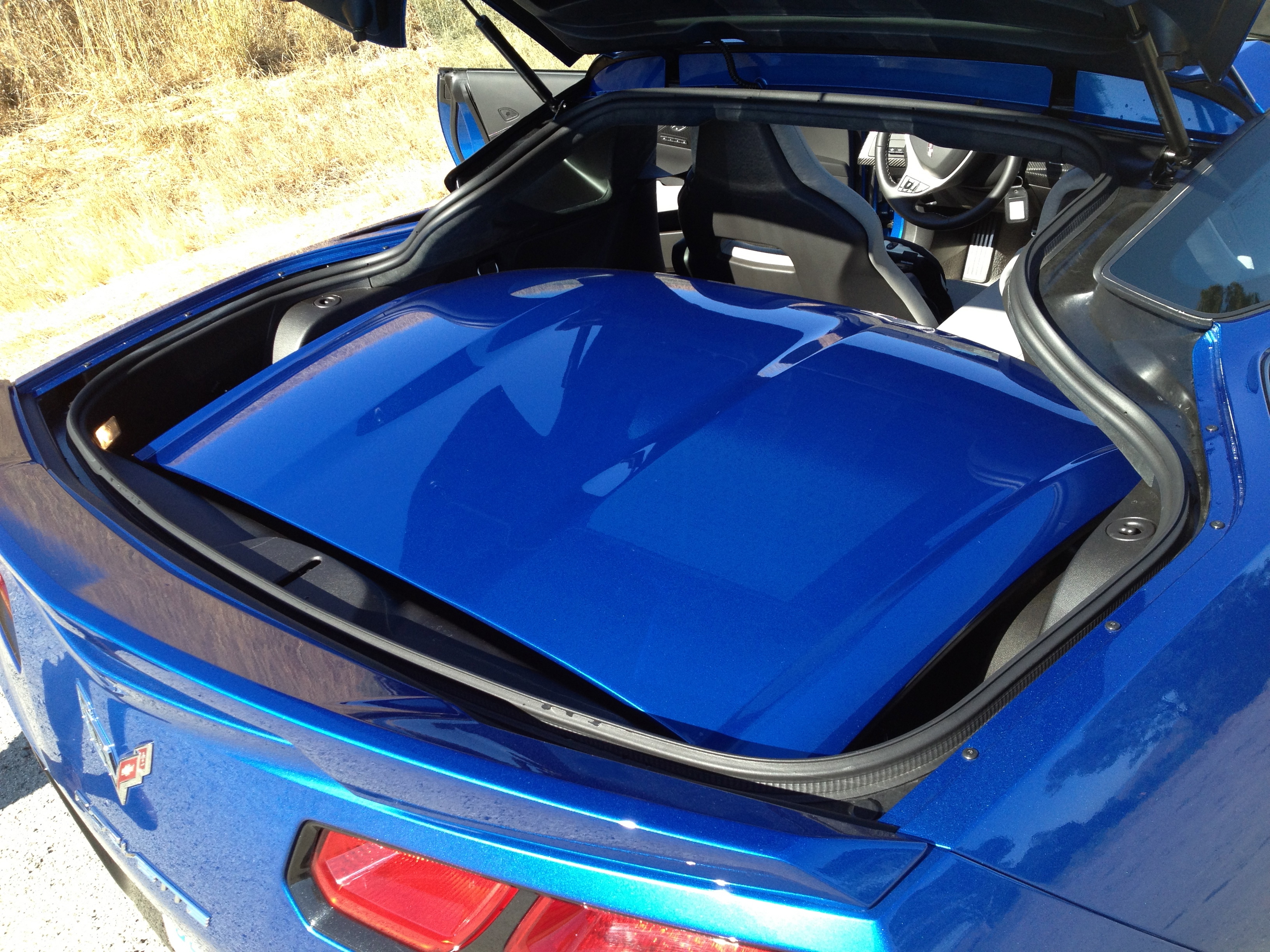
In an attempt to keep the new Stingray as light as possible, there's a lightweight carbon-fibre hood and removable roof panel (that stows neatly under the rear glass hatch), and a lighter aluminum body frame.  Other standard kit includes Michelin tires, electronic limited-slip differential, rev-matching on the manual gearbox and an exclusive technology that senses tire temperature to fine-tune the Corvette's chassis.
IMG_0851
In the past, sports car snobs looked down on the 'Vette's Toys-R-Us plastic interiors and gaping gaps between its Fiberglass body panels, but Chevrolet has amped up the C7 Corvette's perceived quality both inside and outside the car.

An all-leather interior upgrade is available, but even the base model's interior is nicely trimmed and finished with real materials such as aluminum, leather and carbon fibre.  The combination of a new power tilt/telescopic steering wheel and eight-way power buckets (modeled after Porsche and Recaro thrones) also offers plenty of adjustments to fit any driver.  On the outside, Chevy is bragging that the new Corvette's composite panels are now only separated by three-millimeter gaps, comparable to metal-body cars.

So the 2014 Corvette Stingray seemingly has all the latest sportscar "must haves" checked off, but after a day spent driving pre-production manual and automatic transmission models in and around Monterey, Calif., it's safe to say that the latest version of America's sports car is by far the best.

Feel free to pooh-pooh the fact that the Corvette Stingray's "new" 6.2-litre V8 still sports pushrods instead of overhead cams, but the addition of direct fuel injection and new combustion chambers means the Chevy's 460 horsepower and 465 pound-feet of torque out-spec a Porsche Cayman S, 911 Carrera or Jaguar F-Type S.  And the result is a zero-to-96-km/h time of just 38 seconds, whether with the stick or the auto - more than a second quicker than all the above foreign sports cars.

With new cylinder deactivation technology (that effectively turns the V8 into a 126-hp four-cylinder), the Corvette Stingray can also claim "best in class" fuel economy estimates of 12.2 L/100 km in the city and 6.9 on the highway.

At the heart of the Corvette Stingray's driver-focused high-tech package is the cockpit-mounted Driver Mode Selector.  Via five settings - Weather, Eco, Tour, Sport and Track - you can tune the Chevy for a variety of driving desires.  For drivers more interested in chasing Porsches and Jags, the Stingray's optional Z51 performance package (which includes larger-diameter wheels, bigger front brakes, dry sump, lubricant coolers, more-aggressive gear ratios and an electronic differential) and magnetic-ride control system with performance traction management will come to your aid.

Let's skip right to Track model, where the Corvette Stingray's electronic diff, stability control, magnetic shocks and traction control are set at the car's most aggressive levels.  Add to the mix the huge grip found on the standard Michelin Pilot Super Sport rubber, and Chevrolet claims the Stingray will post a 1.08-g cornering score, which is the same as the outgoing (and track tire-equipped) Z06 and ZR1.  (I'd opt for the Z51 package if only to get its Brembo calipers and grooved rotors.  Compared to the non-Z51 Stingray I drove, the Z51 stops were shorter and more confidence-inspiring.)

While the six-speed autobox-equipped Stingray worked best employing its manumatic mode, the new seven-speed manual is more engaging.  For those who don't know their toe from their heel, the big news is a rev-matching feature that can be turned on or off, but improved gear synchros and a dual-mass flywheel make the 'Vette's seven-speeder relatively easy to manage, save for the shift from seventh to sixth, which can be tricky.

Admittedly, steering aficionados will find the Corvette Stingray's new electrically assisted steering could use more feel, but its responses are crisp and accurate, especially in Sport or Track models.  And when you're not out Porsche or Jag hunting, the new Stingray can be tuned to be a comfortable, all-day kilometer muncher.

The GM media people purposely mapped out a route that had us driving over untypically rough California pavement, and the new 'Vette was rock solid, relatively quiet, comfortable and rattle free.  That said, one dip into its throttle and the Corvette Stingray's two-way mufflers will create a boastful blast of good ol' American muscle.

Despite the abundance of high-tech gear and a huge increase in quality, comfort, features and gains in performance and fuel economy (whew!), the Corvette remains a stunningly good value.  The base 2014 Corvette Stingray starts at $54,454 - an almost $8,000 reduction from last year.  Even with the Z51 package and magnetic-ride control system, the price is still less than $60,000 - a big discount over a $74,885 Porsche Cayman S, $98,215 Porsche 911 Carrera or $91,043 Jaguar F-type S.

Perhaps the best news for 'Vette fans (and those who may be considering the Chevy sports car for the first time ever) is that the base model Stingray is just the appetizer.  This fall, a full convertible Stingray arrives, and we can look forward to the higher-performing Z06 and ZR1 replacements.

More than a number on a GM sales chart, the 2014 Corvette Stingray is a knife-edge-styled, rubber band-tired, corner-conquering, weapon of destruction that showcases the very best General Motors has to offer.  Foreign sports car fans can keep their noses upturned at America's sports car, but they'll be missing out on one of the most sophisticated and capable rides you can buy - regardless of the price.